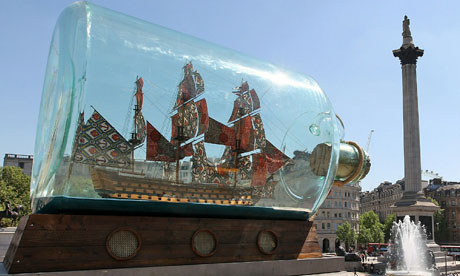
Since its instillation the sculpture has received mixed reviews from the public which is understandable. The concept is a little confusing as there are so many different things going on simultaneously. It is inspired by a photograph of Margot Fonteyn but the figure is based upon the ballerina Melissa Hamilton.

Melissa Hamilton photographed by Andrej Uspenski
It is supposed to evoke childhood memories of those musical jewellery boxes which I think it does marvelously giving it a lovely modern twist.

I used to have one just like this
However when examined within the context of Yinka Shonibare's work some light can be shed upon this complex web of inspirations. Yinka Shonibare was born in London, grew up in Nigeria and studied in England and now works in the East End of London. Unsurprisingly his work often focuses upon the issues of colonialism, identity, globalisation, race and class to name but a few.
Ballet is and always has been tied up with all of these issues. It is to this day considered to be a realm reserved for the upper classes. Yet as Degas' work famously shows it involved some the poorest members of society the 'Petit rats' the young dancers who had to seek rich protectors. Furthermore nowadays you can buy seats at the Royal Opera House to see the ballet from as little as £3 considerably less then the cinema which no one would consider upper class.

Degas, Dancers in Blue 1895 Musee d'Orsay Paris
Suddenly the inclusion of a Victorian globe seems appropriate as Ballet is so strongly linked with this era. But in the Victorian period it was only foreign European ballet troupes that performed in London. There was not a school of British Ballet until the 1920's. This illuminates how complex identity can be and Shonibare's work forces us to examine how these identities are constructed.
Personally I love it and having discovered it's existence can not help but walk the long way to Covent garden every time to see it again. I think it is so appealing not only because it forces you to question what you think you know but also because visually the work is impressive. Scratch that it's beautiful particularly at night when the lighting works to marvelous effect. So next time you are passing don't forget to look up.
I can't wait to see more work from this artist and will be heading to his solo exhibition at the Stephen Friedman Gallery as soon as I can after it opens on the 16th March.
For more information on Yinka Shonibare's work click here and enjoy.