Monday, 4 May 2015

Poetic Pairing: May 2015

Peaches in a Basket 1948 Allan Gwynne Jones Tate

From Blossoms

From blossoms comes
this brown paper bag of peaches
we bought from the boy
at the bend in the road where we turned toward
signs painted Peaches.

From laden boughs, from hands,
from sweet fellowship in the bins,
comes nectar at the roadside, succulent
peaches we devour, dusty skin and all,
comes the familiar dust of summer, dust we eat.

O, to take what we love inside,
to carry within us an orchard, to eat
not only the skin, but the shade,
not only the sugar, but the days, to hold
the fruit in our hands, adore it, then bite into
the round jubilance of peach.

There are days we live
as if death were nowhere
in the background; from joy
to joy to joy, from wing to wing,
from blossom to blossom to
impossible blossom, to sweet impossible blossom.

Li-Young Lee

Thursday, 23 April 2015

Art in Details: With a St. George's Day theme


Today's Art in Details is from a portrait of Sir Henry Lee painted by Marcus Gheeraerts II in approximately 1600. I have focused in on the badge that hangs from his expensively jeweled Order of the Garter collar. This badge known simply as 'the george' shows a triumphant St. George on his rearing steed about to hack apart the green and red dragon at his feet. For a small detail the artist has got a remarkable amount of vitality and movement into the object. George's cape and the horses tail are whipped into movement and the dragons neck twists almost painfully around to observe the oncoming attack. That so much care has been taken in the representation of this detail is likely to reflect the honor that the sitter felt in being included in this exclusive order.

Sunday, 12 April 2015

Art in Details: Joseph Wright of Derby


Here I have focused in on a small section of unquestionably the artists most famous work the air pump experiment. I have chosen this particular section as it effectively displays his masterful handling of light falling on surfaces. In the centre of the detail is the air pump itself the light bouncing off the reflective surface creating strong contrasts of light and dark. This is particularly evident when we compare the treatment of the metal cylinders with the wood or stone ones where he has used a more subtle graduation of tones to suggest a matte effect. One of my favourite elements of this detail is that you can just see a ghost of the candle from which the light emanates through the murky translucent water in the glass bowl.


Friday, 10 April 2015

Art Movements and the Apple

My brief and very oversimplified history of art movements through the eye of the humble apple

Ancient


My earliest example is this silver coin dated to 560-546 BC from the British Museum it could be a pomegranate but I see an apple. Many pre-Roman coins did not have the rulers faces on them that we have become so accustomed to seeing. Often instead they had simplified images of animals or objects and in this case fruit.

Greek


This frieze from a Greek vase shows the Hesperides or nymphs who were the daughters of Atlas. Alongside the Ladon the 100 headed dragon, shown here as really more of a snake, they are guarding the golden apples belonging to Zeus.

Roman


Fresco found at Pompeii from the second style from the 1st century BC preserved by the eruption of Vesuvius we can see that people have always been fascinated by still life.

Romanesque


The temptation of Eve by the sculptor Gislebertus c.1130 Musee Rolin. 

Medieval


A page from an illustrated manuscript c.1445 showing God pointing out the apple to Adam and Eve from the New York Public Library

Italian Renaissance


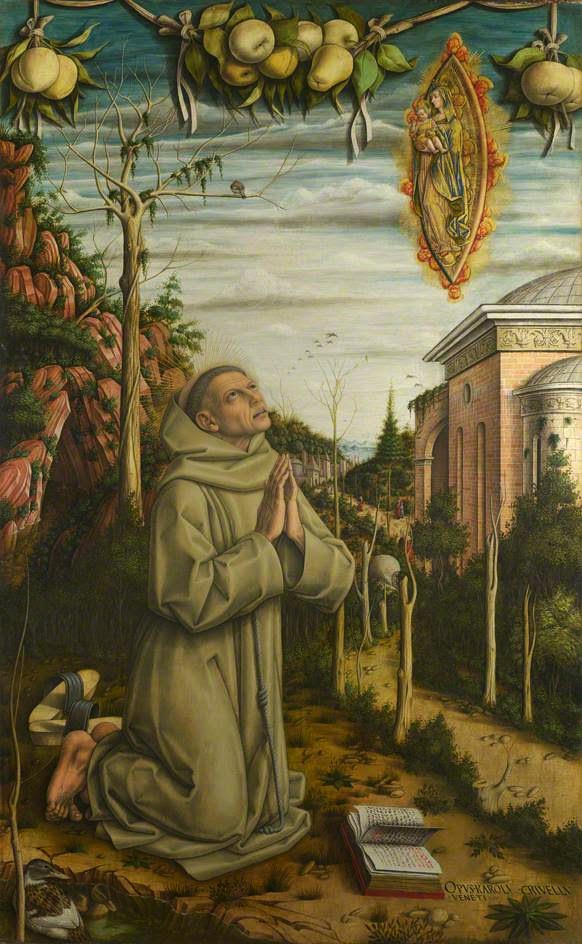
Carlo Crivelli The Vision of the Blessed Gabriele from the National Gallery. Carlo Crivelli often included apples and pears in his depictions of the Madonna and Child. Here we see Gabriele the superior of a Franciscan convent having a vision of the Virgin Mary and baby Jesus in a Mandorla (Almond shaped apparition) on the top right. The Mandorla is surrounded by large green apples.

Northern Renaissance


Lucas Cranach's Mother and child are seated under an apple tree abundant with ripe fruit.

Baroque


Caravaggio's c.1599 fruit basket with its careful details starts to take us into the flamboyant lush and luxurious Baroque and Rococo styles. Caravaggio's fruit is far from perfect and idealised like the previous two images. He has painted every bruise every rotten worm hole. This image is also notable as it is considered by many to be the first example of a still life of a basket of fruit, which became such a staple part of the still life genre.

Neoclassical


I wouldn't have thought you get get a neoclassical apple but I was wrong. Here in John Vanderlyn's 1854-1858 painting from the Albany Institute of history and art the carefully rendered apples are set in a mock classical setting on an ornate marble tabletop.

Pre-Raphaelite/Romanticism


Rossetti's Venus Verticordia 1863-68 who sits shrouded in roses and a luminous halo holds a golden apple on which is perched a bright yellow butterfly.

Realism


Courbet

Courbet's apple is hidden in the background. He has taken particular care to paint the fruit's irregularities. Gone are the perfect spheres and consistent colours of Cranach's uniform apples. 

Impressionism


Renoir

Here we can see all the colors that Renoir injects into the white cloth the apples sit on. The apples themselves are painted with the artists strong brush strokes and particular care has been taken to convey the bright specks of light reflecting on the apples shiny surfaces.

Post-Impressionism


Cezanne painted hundreds of apples during his lifetime. He really explored the apple as a form seeking to understand its shape from every angle and how to convey that in paint. He changed the way that artists looked at objects.

Abstraction - Well the move towards it


In this painting by the abstract artist Ben Nicholson we can see how he has broken down the apple to its fundamental geometrical elements in this move towards abstraction.

Surrealism


In one of Magritte's most famous paintings the Son of Man an exaggeratedly perfect green apple hangs suspended in space in front of a gentleman's face. The smartly dressed gentleman is Magritte himself.

Pop Art


One of Warhol's series of colourful screenprints of the Macintosh logo. Warhol once met a young Steve Jobs at a party for the 9 year old Sean Lennon. Job's had given Sean an early Macintosh computer and was teaching everyone to use paint including Warhol himself.

Contemporary


Anne Rook uses the stickers from familiar brands of apples and sticks them to the apple itself in the Book of Golden Delicious 4021 4020. She is commenting on consumer culture, mass production and globalisation of food production.

Thursday, 2 April 2015

Poetic Pairings: April 2015

A Painting and a Poem that reflect the anxieties of city living.


George Grosz Metropolis MOMA 1917


He Dreams of Falling

At the table in patio seating,
a young man starched into my evening
in waiter black and white--
he's probably named John, Tom,
something less spectacular than the busboy 
named Ari at the table beside me.
He is a boy I've seen and I hide that from him,
a silence he doesn't understand as he turns away 
not remembering that a week ago while waiting for a bus
I saw him step over the legs of an old
homeless woman
sprawled on the sidewalk. His foot
not clearing her arm, caught,
so that he jerked her body
while a consciousness
almost found her but didn't,
just stirred somewhere below her face.
In the spiral where he turned he glanced 
not at the woman but to see who'd seen.
He saw me watching him, jack-lighted and drawn
into the warm ceremony that fell through him.
I understood this explosion,
the burn from the beginning,
there when a bus passes, or a waiter
quietly puts down your check.
He could be my brother,
have parents at home in Ohio where there is a small lie
buried in a garden with snow peas and basil.
There may be another breaking the soil,
dogs who bark into the woods,
constellations who see our freeways as spines--
or he may miss a warm climate,
groves of oranges measuring the circular
scent of weight each time a heavy fruit falls.
He may know that secretly 
the hearts of children conspire to stop 
when parents close their bedroom doors.
But in this construction,
the pace that takes him back and forth
in the servitude of strangers,
he has forgotten, again, to feel for me,
eating alone, a woman familiar
deep in the eyes,
with his same knowledge of movement
that bends us forward,
the instinct of our heels
ready to turn against that jerk a body makes 
even in dead sleep,
the stir that is less than we ask for,
less than an old woman,
or a woman growing old.

Ruth Ellen Kocher

Monday, 30 March 2015

The Bed is Back: Tracey Emin's My Bed at Tate Britain

It has been 15 years since Tracey Emin's Bed was last shown at Tate when it was the most talked about nominee for the Turner Prize.

Since then like the artist herself it has been on quite a journey. It was bought by Saatchi who exhibited it in both his gallery and his own home. In 2014 it was bought by Count Christian Duerckheim for a staggering £2.5 million. The Count in turn has lent it to the Tate gallery for a period of 10 years.

So much has been written about this work that I will not dwell on its history and the impassioned debates it inspires about what art is, how meaning is stored in objects, the importance of authentic objects and sensationalism. Although of course these are all important parts of what makes it what it is.


What interests me about this work is seeing it again at the Tate. It is easy to think that permenant collections stay the same but they are always changing and now My Bed is seen alongside a range of works that open up a fasinating dialogue with it. It has gone from being part of the temporary Turner Prize exhibition to being seen as an integral part of the history of British art.

Emin has helped curate the room in which the work itself will be shown. She has chosen to show it alongside some of her ink drawings produced in 2014 and gifted to the gallery and two works by Francis Bacon. The impression these dynamic works create in this small space is one of turbulence reflecting her emotional state at the time that the bed was conceived. The link with Francis Bacon is a logical one the two artists share a hair trigger and emotional turbulence they both lived big and fast and as a result their work is expressive and charged with their respective personalities and pains.


But of course the room is a small part of the overall gallery and seeing it there got me thinking about some of the other links. One that sprung immediately to mind is a Tate Britain favourite Henry Wallis' The Death of Chatterton. It is no secret that Emin's Bed is considered a self portrait of the artist in her darkest moment although it is sometimes forgotten that in an earlier incarnation a hangman's noose used to hang above it making the theme of suicide more explicit. It is interesting to look at the similarity between the works despite the fact that they belong to such different traditions. We see Chatterton in his bed with the signs and symbols of his life strewn around him. Instead of condoms suitcases and vodka bottles we have a discarded coat, torn up letters and an arsenic bottle.


A second connection which I am sure is not entirely coincidental is the fact that this display coincides with the Nick Waplington/Alexander McQueen show. McQueen took his life in 2012 and it is a theme that is difficult to entirely forget as you go around the exhibition. You get the sense that he was preoccupied with his own legacy with creating something memorable and getting all of the information down through his clothes and through the photo book the two produced together. In the Exhibition Susannah Frankel talks about McQueen being very aware of the Horn of Plenty as his last collection as a young man. The Juxtaposition of My Bed and this reflection on McQueen in the same gallery suggest a dialogue between creativity, survival, legacy and youth.

The Final link that occurred to me is a more general one. Looking at the bed now it is clear that it has become something else it is a sort of time capsuale not just of Emin's life and the history of the Young British Artists but of the 90's. As you go through the gallery from the 1600's to the present day you see a series of moments they are shown to be distinct by the objects included in them. Take The Portrait of William Style of Langley on show in the 1640 room.


We do not know the artist of this work but it can be dated to the 17th century because of the fashion and the objects shown within it. The same is now true with Emin's Bed. The fact the Marlboro cigarettes do not have health warnings, the old fashioned orangina bottle even the type of razor these details all date the work. They allow us to look at it through a different lens making it not just an art work but an artifact.

There are so many more connections to be discovered so I do encourage anyone to come and have a look My Bed will be on show at Tate Britain from 31st March 2015.

Art in Details: Peter Monamy

This will be the first in my series of Art in Details posts.

One of the wonders of looking at art from any era is discovering something in it that you had not seen before or that captures the imagination. At one point it was very popular to have whole books full of details from paintings and now one of the major developments in gallery and museum works is to make works available on the internet with high quality images that you can zoom in on.

These posts will be in that tradition but just focusing on one small detail with the briefest of blurbs. So here goes!


Amidst Peter Monamy's dramatically stormy seascape we are shown a glimpse of two desperate sailors clinging to the rigging of a ship that has just been submerged by a white frothy wave. Looking at the scene you can almost hear the chaos around you and sense their fear. This small detail is a powerful image of the human will to survive pitted against the ferocity of nature.